
Categorizing Reality and Higher Order Thinking
Understanding the nature of reality, its attributes, and how to think about things external to it.
Introduction
Categories are a useful tool for understanding the nature of reality. They allow us to see how things are related to each other, and what attributes they’re comprised of.
The Issues That Occur Without Understanding Categories
When discussing topics such as the existence of a creator, sometimes people make the mistake of assuming that the creator must follow the same laws as reality. An example of this is assuming that if our reality is created, then it must follow that the creator is also created, and there is an infinite chain of creators. This fails because we are applying our reality’s logic to a creator above our reality.
What We Can Determine About a Potential Creator Using Categories
First, let’s define a relation between reality and its creator.
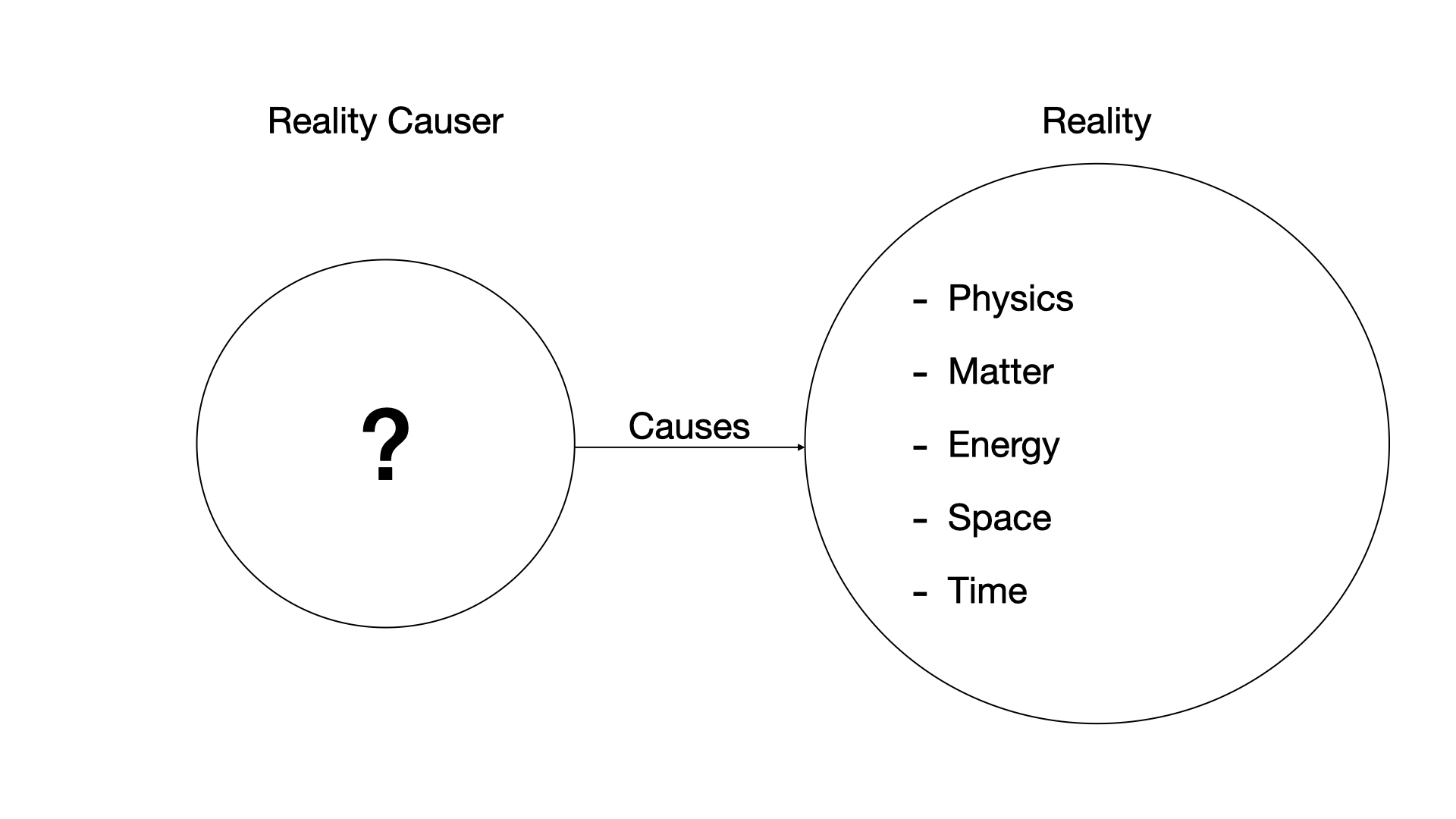
We can see that within the category of reality, we have defined attributes that make up our existence. These aren’t all of the attributes of our reality, but they are just an example of what is contained within reality.
Within the category of creator, we have a question mark, representing the unknown attributes of the creator. We also have a relation defined between creator and reality, showcasing that a creator creates reality.
With this set up, we can now determine facts such as these about the creator:
- Whichever attributes the creator created in reality, the creator doesn’t necessarily have itself.
- The creator created us, and therefore we can say our existence is contingent on the creator.
- We can logically come to the conclusion that we were caused by the creator, but it isn’t necessarily so for all causal relationships. A reality created without the attribute of logic would not be able to even begin to think about the causation of its own existence.
This is not the only way to envision a creator, but it’s useful for showing the limits of certain properties. Logic being a rule of our reality makes it so that it isn’t necessarily applicable outside of our reality; it is simply unknown. Our gap in logic itself however is what allows us to determine the relationship part, ie. the arrow in the diagram.
Another way you can look at it is this:

This still makes reality contingent on a creator category, except this time, it’s represented as a subset of the creator category, which we are calling here “hyper-reality”. If this is the actual relationship, then it has other interesting implications:
- Our reality being a subset of a hyper-reality means that the we are “a part of” the hyper-reality and not simply “caused by” it.
- The logic of our reality can be considered contained within the hyper-reality, but not necessarily a part of it’s own logic, or interacting with things in the space of the hyper-reality that is outside of our reality.
Visualize Yourself as a Simulation Developer
To picture how these facts work, we can think of them within the context of a computer simulation, or a video game world.
Imagine that you are a simulation developer. In the simulation that you are building, you add the attribute of time. You also create a physics engine for things to move around, and have it so that motion always exists across time.
Within the simulation, anything that exists within it must follow its laws of physics and time. These simulation laws don’t have to reflect the your reality’s laws. They can be completely different (even though in this case they are built in the likeness of your reality’s laws).
Moving forward, you then choose to add characters to the simulation. These characters have memory and can think and reason. The characters that exist within this simulation are able to use their reasoning capabilities to determine that they have laws such as only being able to move one tile. They have the concept of time. They are also able to understand that their laws are not enough to have made them exist, and that there must be something else that caused them to exist. They are not able to guess how you move within your own world, if movement is even possible in your world, or how/if it differs from their own laws. All they can determine is the relationship aspect that connects the creator to reality.
There are workarounds to this of course. You can always allow your characters to develop language, and then you can attempt to communicate with them. This communication of course wouldn’t be explainable using their own laws, so hey, who would even believe you!